

Mango Farming: Unlocking Agriculture Potential

Introduction
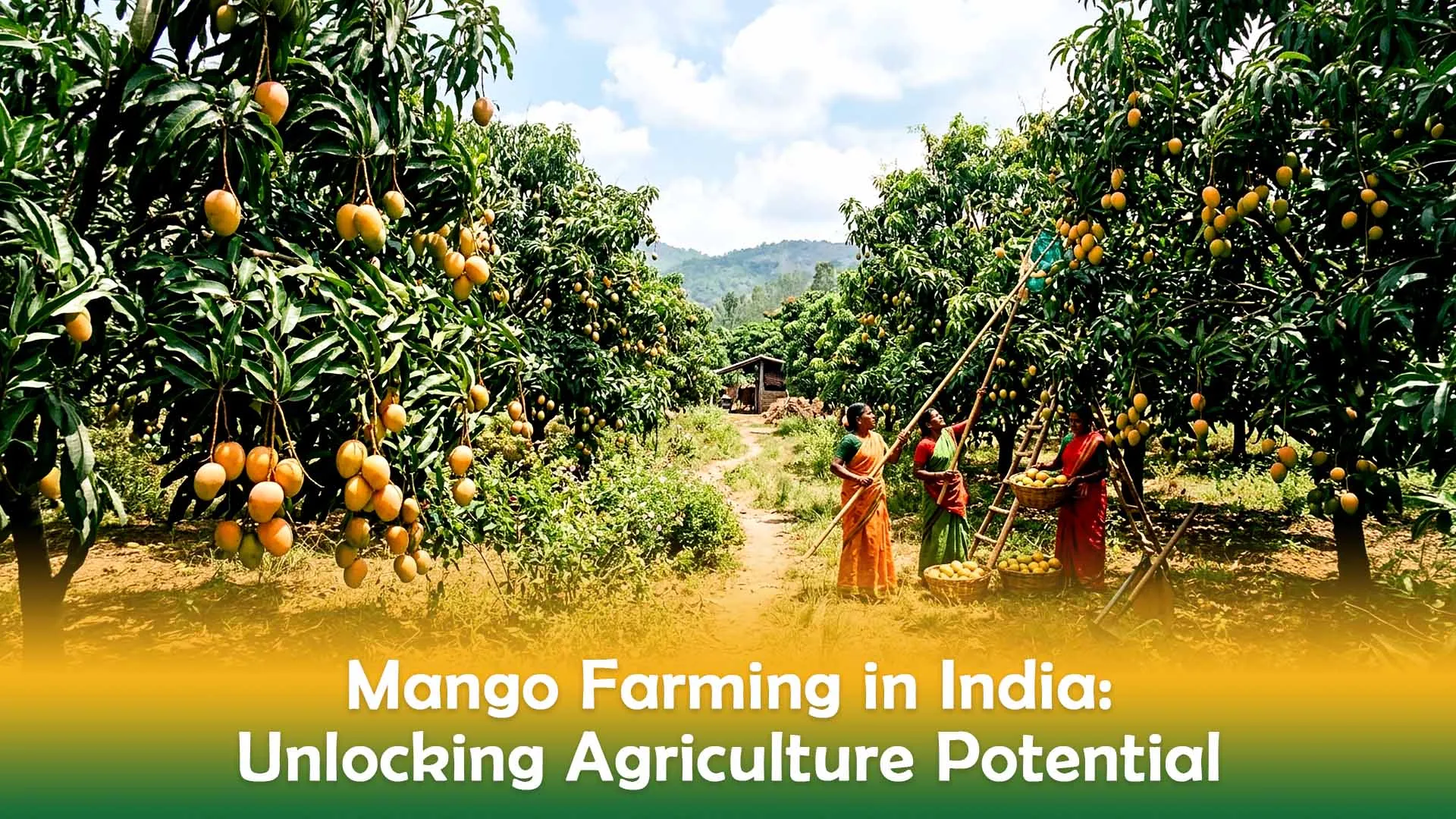
India is an agricultural nation at heart — but for many families with farming in their blood, the land has remained more of a legacy than a livelihood. The real question is: how do you turn inherited land into a thriving enterprise? Mango farming in India holds the answer — and with the right combination of innovation, planning, and modern agricultural practices India can finally begin to realise its full agricultural potential.
Why Mango Farming in India Holds Enormous Promise
India is rightfully called the land of mangoes. With over 1,500 varieties growing across the country and close to 50% of the global market share, mango farming in India dominates world markets from mid-April through July. Yet despite this natural advantage, many farmers leave significant value on the table.
On average, mango farming in India generates between INR 50,000 (roughly USD 540) and INR 2,00,000 (roughly USD 2150) per acre per year. With structured, modern agricultural practices India has long been capable of but slow to adopt, those numbers can improve dramatically. The key is following proven methods from farm management all the way through to packaging and sale.
Farm Management: Building the Foundation for Mango Farming in India
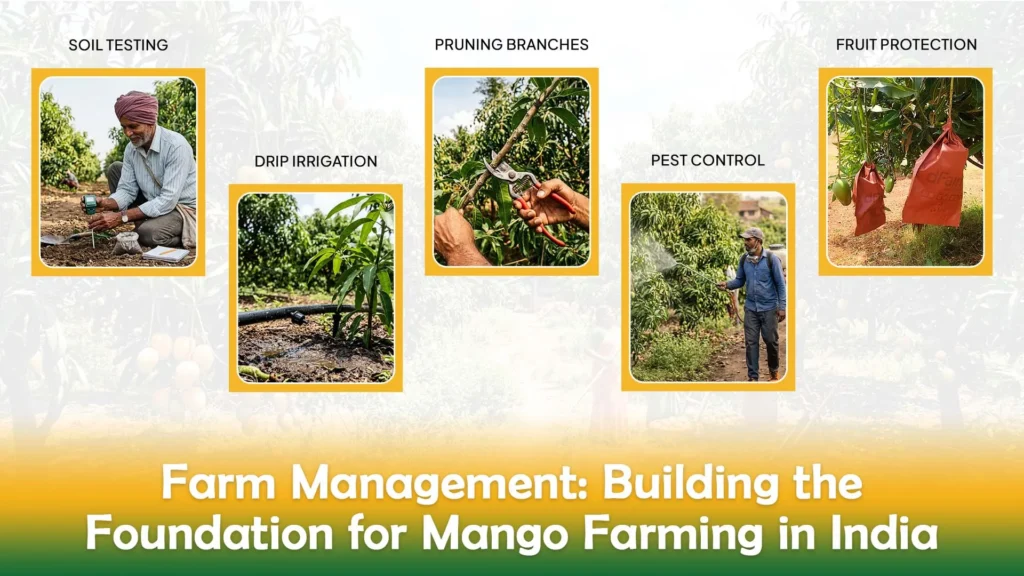
A high-yielding orchard starts with disciplined farm management. Every aspect — soil, water, nutrients, tree health — demands consistent attention. Adopting modern agricultural practices India-wide is what separates average yields from exceptional ones.
Soil management is the starting point. Mango trees thrive in well-drained, organically rich soil. Regular soil testing and targeted use of fertilizers keep the land productive season after season.
Water management is equally critical. Drip irrigation systems are one of the most effective tools for ensuring steady moisture without wastage — a cornerstone of modern agricultural practices India urgently needs to scale.
Nutrient management involves regular application of balanced fertilizers — nitrogen, phosphorus, and potassium — to sustain tree health and support strong fruiting cycles, directly impacting the profitability of mango farming in India.
Pruning, done after harvest, keeps trees healthy, well-shaped, and optimally lit. Removing dead or crossing branches encourages better fruit production in the next cycle.
Pest and disease management rounds out the picture. Mangoes are susceptible to fruit flies, mealybugs, powdery mildew, and mango malformation. Regular monitoring and timely intervention are essential to protect the yield and quality that make mango farming in India viable at scale.
Bagging mango fruits early (using pouches or covers) is a very effective, low-chemical way to protect them. It’s widely used to reduce pests, diseases, and improve fruit quality. Here’s a practical guide you can follow:
When to Start Bagging?
- Begin at early fruit stage (marble size, ~3–5 cm diameter)
- Usually 15–30 days after fruit set
- Do it after natural fruit drop is over
dFarm providing the Mango pouches /bag for its member Farmers / Prospective associates
- Best choice: Paper bags with small ventilation holes
How to Cover Mango Fruits
- Select healthy fruits (remove damaged ones)
- Spray a preventive fungicide/insecticide before bagging (optional but helpful)
- Place bag over fruit carefully
- Tie or staple at the stem (pedicel)—not too tight
- Ensure:
- Air can circulate
- Water doesn’t collect inside
Problems It Prevents
- Fruit fly attack
- Mealybugs
- Thrips
- Sunburn
- Dust and pesticide residues
- Bird damage
Benefits
- Cleaner, blemish-free fruits
- Better color and uniform ripening
- Reduced chemical spraying
- Higher market value
Important Tips
- Don’t bag too early (fruit may drop)
- Don’t bag too late (pests may already enter)
- Check periodically for moisture or fungal growth
- Remove bags 3 to 7 days before harvest (optional, for color development)
Harvesting: Timing and Technique Matter
Getting the harvest right is one of the most underappreciated aspects of mango farming in India. A fruit is considered mature only when it has reached the stage where both external and internal quality will satisfy consumers after ripening.
Maturity indicators to watch for include a flat shoulder at the stem end, a white powdery bloom or colour shift in the peel, and light creamy-yellow pulp. Harvesting too early means inferior flavour — even if the mango looks ripe later.
Time of day makes a real difference. The recommended harvesting window is between 6:00 a.m. and 10:00 a.m. to minimise latex flow. Latex burns are a leading cause of rejection in export and premium markets, making this detail critical for anyone serious about mango farming in India.
Harvesting method should be meticulous. Fruits are hand-picked using poles fitted with net bags, placed into clean plastic crates, and handled carefully to prevent cuts or contamination. Harvesters should maintain good hygiene, leave 3–4 cm of stem attached to divert latex flow, and keep fruits shaded to prevent heat buildup.
Mango Post-Harvest Management: Where Value Is Won or Lost
Strong mango post-harvest management is arguably the area where the most money is either made or lost. Mangoes are perishable, and post-harvest losses remain one of the biggest financial drains in Indian agriculture. Good mango post-harvest management starts the moment the fruit leaves the tree.
Trimming and delatexing are the first steps — removing excess stem and clearing fresh latex to prevent staining that can disqualify fruit from premium markets.
Sorting and grading determine market destination. Class A quality goes to export and institutional buyers like supermarkets and hotels; Class B serves the domestic market. Consistent grading, as part of a disciplined mango post-harvest management process, directly drives revenue.
Hot Water Treatment (HWT) is the gold standard of post-harvest care. Dipping mature green mangoes in water heated to 52–55°C for 5 to 10 minutes kills disease-causing organisms without harming the fruit. It also removes latex and surface dirt — a chemical-free solution central to effective mango post-harvest management that significantly extends shelf life.
Ripening must be equally precise. Mangoes treated with a ripening agent and held at 68–72°F (20–22.2°C) will ripen uniformly in 2 to 3 days. Fruit harvested immature will never develop full flavour, regardless of what mango post-harvest management steps follow.
Gamma irradiation completes the toolkit. It eradicates pests like fruit flies, extends shelf life, and eliminates pathogens such as E. coli and Salmonella — critical for export compliance and a mark of truly professional mango post-harvest management.
Packaging and Transportation: The Final Mile
Packaging is the bridge between the farm and the consumer, and it is an area where modern agricultural practices India has room to grow significantly. Good packaging protects the fruit during transit, communicates product quality, and enables traceability. Materials must provide adequate protection, handle logistics demands, and appeal to buyers. Traceability built into packaging opens doors to premium and export markets that require documented supply chain visibility — further elevating the standard of mango farming in India.

Conclusion
The mango story in India is much more than a story about fruit. It is a proof of concept for what mango farming in India can become when it is taken seriously. When traditional knowledge is paired with modern agricultural practices India has access to — precise harvesting, robust mango post-harvest management, and smart packaging — the results are transformative for individual farmers and the broader economy alike.
The potential is not theoretical. With the right practices in place, mango farming in India can move from a legacy to a globally competitive business, feeding millions and standing as a model of what focused agricultural innovation can achieve.
Frequently Asked Questions (FAQs)
1. How much can a mango farmer earn per acre in India?
On average, mango farming in India generates between INR 50,000 and INR 2,00,000 (approximately USD 540–2,150) per acre per year. This varies depending on variety, farm management quality, and market access — with premium and export markets yielding significantly higher returns.
2. What is the best time to harvest mangoes to support good post-harvest outcomes?
Harvesting between 6:00 a.m. and 10:00 a.m. minimises latex flow and reduces the risk of latex burns. Proper harvest timing is the first step in effective mango post-harvest management, as fruit harvested at the wrong time or maturity stage will not respond well to any post-harvest treatment.
3. What is Hot Water Treatment and why is it essential to mango post-harvest management?
Hot Water Treatment (HWT) involves dipping mature green mangoes in water at 52–55°C for 5 to 10 minutes. It is the most effective non-chemical method for controlling decay, removing latex, and extending shelf life — making it a cornerstone of professional mango post-harvest management.
4. How do modern agricultural practices in India improve mango yields?
Modern agricultural practices India farmers are increasingly adopting — such as drip irrigation, soil testing, balanced fertilisation, and integrated pest management — directly improve tree health, fruit quality, and overall yield. These practices reduce input waste and increase the profitability of each acre under cultivation.
5. What maturity signs should a farmer look for before harvesting mangoes?
Key indicators include a flat shoulder at the stem end, a colour shift or white bloom on the peel, and light creamy-yellow pulp. Identifying these correctly is critical for mango farming in India, as premature harvesting results in fruit that will never develop full flavour — impacting both market value and consumer satisfaction.


Very informative post 👍 Learned a lot about mango harvesting and post-harvest management. Thanks for sharing!